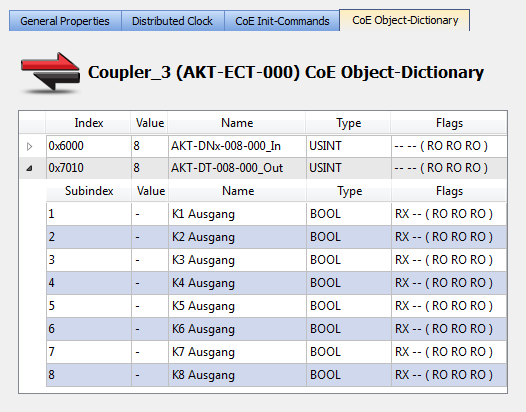
This tab displays the all the CoE (CAN"Controller area network" CAN is a broadcast, differential serial bus standard developed for connecting electronic control units. Each node is able to send and receive messages, but not simultaneously over EtherCATEtherCAT is an open, high-performance Ethernet-based fieldbus system. The development goal of EtherCAT was to apply Ethernet to automation applications which require short data update times (also called cycle times) with low communication jitter (for synchronization purposes) and low hardware costs) objects associated with the EtherCAT device. It is used as reference to add new CoE Init Commands for the EtherCAT device. The fields in the table are described below. The CoE objects can be used for three different actions, depending upon the access flags.
This tab is grayed out if the ESI file does not have CoE object information, or if the file is unavailable.
CoE objects can be composed of a simple data type or a complex type. In case of a complex data type, each simple data type composing it has a SubIndex . As shown in the example below, the CoE object can be expanded to show all the subindex's details that are the same as the details for a simple type CoE object.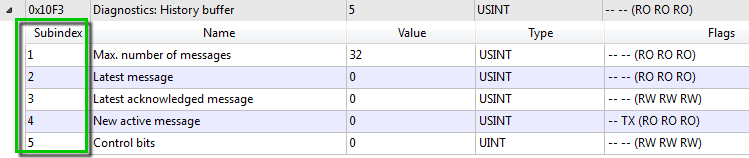
| Field | Description | ||||||||||
|---|---|---|---|---|---|---|---|---|---|---|---|
| Index / SubIndex | CoE Index or SubIndex number | ||||||||||
| Name | Name of the CoE object | ||||||||||
| Value | Default value of the CoE object | ||||||||||
| Type | Data type of the CoE object | ||||||||||
| Flags |
This column contains 5 values in the format XX YY (AA BB CC), each representing an access option. The values of XX and YY provide PDO mapping options:
The values for AA, BB, and CC provide the CiE Access type. The values can be read only (RO), read-write (RW), or write only (WO)
|
||||||||||
| Module | Name of the module that is associated with the CoE Object |
|
Stay Connected with Kollmorgen       
|
Copyright © 2015 Kollmorgen™ |
|