 to add the Fieldbus configuration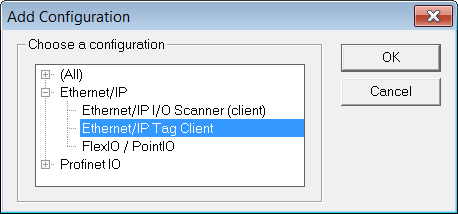
The KAS RuntimeIn computer science, runtime (or run-time) describes the operation of a computer program, the duration of its execution, from beginning to termination (compare compile time). Within KAS, runtime also refers to the virtual machine that manage the program written in a computer language while it is running includes fully integrated EthernetEthernet is a large, diverse family of frame-based computer networking technologies that operate at many speeds for local area networks (LANs)/IP client driver for exchanging tags with Ethernet/IP tag based devices such as PLCs.
Data exchange - configuration
A dedicated configuration tool is integrated in the KAS IDE"Integrated development environment" An integrated development environment is a type of computer software that assists computer programmers in developing software. IDEs normally consist of a source code editor, a compiler and/or interpreter, build-automation tools, and a debugger.
to add the Fieldbus configuration The configuration is represented as a tree:
(*) The items with this mark can appear several times in the configuration.
DriverIn computing and electronics, a driver is a software component allowing higher-level computer programs to interact with a computer hardware device. A driver typically communicates with the device through the computer bus or communications subsystem to which the hardware is connected and configurator are optimized for exchanging arrays (tags declared as arrays in the PLC"Programmable Logic Controller" A Programmable Logic Controller, PLC, or Programmable Controller is a digital computer used for automation of industrial processes, such as control of machinery on factory assembly lines. Used to synchronize the flow of inputs from (physical) sensors and events with the flow of outputs to actuators and events). However it is also possible to exchange single tags.
Configuration
Click the Insert Master icon  to declare an server (slave device). Each server is identified by its IP address and an optional description text.
Then you need to configure tags such as declared in the PLC:
 to declare the tag and map some variables later on.
A tag request is identified by:
| Identifier | Meaning |
|---|---|
| Tag name | The name of the tag such as declared in the PLC |
| PLC Slot | PLC slot number |
| Mode | Read or Write (note that the same tag can be configured twice for both reading and writing) |
| Nb Elements | Number of array items to read or write |
| Offset | O-based index of the first item to read or write in the array |
| Tag data type | Data type of the tag such as declared in the PLC. Available Types are:
|
| Period(ms) | You can specify in this parameter a period for continuously sending the request. Enter "0" for a request sent "on demand" |
| Timeout | Request timeout in milliseconds |
IEC61131IEC standard for Programmable logic controllers (PLCs)-3 variables are mapped on the data of the tag, for each variable you must specify:
| Identifier | Meaning |
|---|---|
| Symbol | The name of the IEC61131-3 variable |
| Offset | Offset in bytes in the assembly data |
| Bit | Bit offset in the selected byte if format is "Bit" |
| Format | Format of the data in the assembly |
| Mode | Kind of data exchanged through the variable:
|
The tag will be read or written:
In the case of a command variable, the variable is automatically reset to FALSE when the request is sent.
The data limit is: 500 bytes of data maximum O(originator)->T(target) and 500 bytes of data maximum T(target) -> O(originator). This is based on the Ethernet/IP specification.
|
Stay Connected with Kollmorgen       
|
Copyright © 2015 Kollmorgen™ |

|