
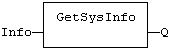
INFO : DINT Identifier of the requested information
Q : DINT Value of the requested information or 0 if error
The INFO parameter can be one of the following predefined values:
| Value | Definition |
|---|---|
_SYSINFO_TRIGGER_MICROS |
programmed cycle time in micro-seconds |
_SYSINFO_TRIGGER_MS |
programmed cycle time in milliseconds |
_SYSINFO_CYCLETIME_MICROS |
duration of the previous cycle in micro-seconds |
_SYSINFO_CYCLETIME_MS |
duration of the previous cycle in milliseconds |
_SYSINFO_CYCLEMAX_MICROS |
maximum detected cycle time in micro-seconds |
_SYSINFO_CYCLEMAX_MS |
maximum detected cycle time in milliseconds |
_SYSINFO_CYCLESTAMP_MS |
time stamp of the current cycle in milliseconds (OEM"Original equipment manufacturer" A term that refers to containment-based re-branding, namely where one company uses a component of another company within its product, or sells the product of another company under its own brand. OEM refers to the company that originally manufactured the product dependent) |
_SYSINFO_CYCLEOVERFLOWS |
number of detected cycle time overflows |
_SYSINFO_CYCLECOUNT |
counter of cycles |
_SYSINFO_APPSTAMP |
compiling date stamp of the application |
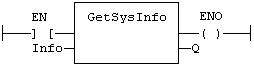
In FFLD language, the operation is executed only if the input rung (EN) is TRUE. The output rung (ENO) keeps the same value as the input rung.
In IL"Instruction list" This is a low-level language and resembles assembly, the input must be loaded in the current result before calling the function.
Q := GETSYSINFO (INFO);
(* The function is executed only if EN is TRUE *)
(* ENO keeps the same value as EN *)
|
Stay Connected with Kollmorgen       
|
Copyright © 2015 Kollmorgen™ |

|