 ECATReadData
 ECATReadData
This is a low level function and it should only be used carefully by advanced users.
This function allows a direct access to the memory image of the EtherCATEtherCAT is an open, high-performance Ethernet-based fieldbus system. The development goal of EtherCAT was to apply Ethernet to automation applications which require short data update times (also called cycle times) with low communication jitter (for synchronization purposes) and low hardware costs frame which is sent or received when you need to debug your application. You access the EtherCAT image element by giving the offset in the image and the size of the element.
If you have a device other than the drive, ECATReadData is used for more than just debug. It is used to get the status of the module (e.g. Stepper I/O slice).
| Offset | Description | Offset in bytes from the beginning of the frame |
| Data type | UINT | |
| Range |
0-size of frame (maximum size of an EthernetEthernet is a large, diverse family of frame-based computer networking technologies that operate at many speeds for local area networks (LANs) frame is 1500) |
|
| Unit | bytes | |
| Default | — | |
| Nbytes | Description | Number of bytes to read |
| Data type | SINT | |
| Range | 1, 2 or 4 | |
| Unit | bytes | |
| Default | — | |
| Direction | Description | Direction of the frame (true = output image, false = input image). |
| Data type | BOOL | |
| Range | 0, 1 | |
| Unit | n/a | |
| Default | — |
| Value | Description | Value of the EtherCAT frame |
| Data type | DINT | |
| Unit | n/a |
|
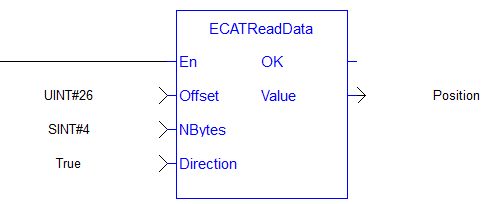
// Read 4 bytes starting at offset 26 of the output image
Position := ECATReadData(26, 4, true);
|

|
Stay Connected with Kollmorgen       
|
Copyright © 2015 Kollmorgen™ |

|
 [Top]
[Top]