
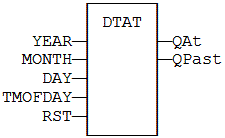
YEAR : DINT Wished year (e.g. 2006)
MONTH : DINT Wished month (1 = January)
DAY : DINT
Wished day (1 to 31)
TMOFDAY : TIME
Wished time
RST : BOOL ResetNew start of the microprocessor command
QAT : BOOL PulseWhen the step gets activated, the action is activated for a single execution, and possibly once again when the step is deactivated signal
QPAST : BOOL True if elapsed
The real-time clock may not be available on all controller hardware models. Please consult the controller hardware specifications for real-time clock availability.
Parameters are not updated constantly. They are taken into account when
only:
- the first time the block is called
- when the reset input (RST) is TRUE
In these two situations, the outputs are reset to FALSE.
The first time the block is called with RST=FALSE and the specified date/stamp is passed, the output QPAST is set to TRUE, and the output QAT is set to TRUE for one cycle only (pulse signal).
Highest units are ignored if set to 0. For instance, if arguments are "year=0, month=0, day = 3, tmofday=t#10h" then the block will trigger on the next 3rd day of the month at 10h.
In FFLD language, the block is activated only if the input rung is TRUE..
(* MyDTAT is a declared instance of DTAT function block *)
MyDTAT (YEAR, MONTH, DAY, TMOFDAY, RST);
QAT := MyDTAT.QAT;
QPAST := MyDTATA.QPAST;
(* Called only if EN is TRUE *)
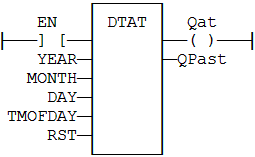
(* MyDTAT is a declared instance of DTAT function block *)
Op1: CAL
MyDTAT (YEAR, MONTH, DAY, TMOFDAY, RST)
FFLD MyDTAT.QAT
ST"Structured text"
A high-level language that is block structured and syntactically resembles Pascal QAT
FFLD MyDTATA.QPAST
ST QPAST
See also
DTEVERY Real time clock functions
|
Stay Connected with Kollmorgen       
|
Copyright © 2015 Kollmorgen™ |
|