
| Inputs | Function | Description | ||
|---|---|---|---|---|
| MOD | MODR | MODLR | ||
| IN | DINT | REAL | LREAL | Input value |
| BASE | DINT | REAL | LREAL | Base of the modulo |
| Output | Function | Description | ||
|---|---|---|---|---|
| MOD | MODR | MODLR | ||
| Q | DINT | REAL | LREAL | Modulo: rest of the integer division (IN / BASE) |
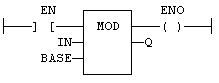
In FFLD language, the input rung (EN) enables the operation, and the output rung keeps the state of the input rung. In IL"Instruction list" This is a low-level language and resembles assembly language, the first input must be loaded before the function call. The second input is the operand of the function.
Q := MOD (IN, BASE);
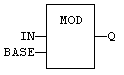
(* The comparison is executed only if EN is TRUE *)
(* ENO has the same value as EN *)
Op1: LD"Ladder diagram"
Ladder logic is a method of drawing electrical logic schematics. It is now a very popular graphical language for programming Programmable Logic Controllers (PLCs). It was originally invented to describe logic made from relays. The name is based on the observation that programs in this language resemble ladders, with two vertical "rails" and a series of horizontal "rungs" between them IN
MOD BASE
ST Q (* Q is the rest of integer division: IN / BASE *)
See also
|
Stay Connected with Kollmorgen       
|
Copyright © 2015 Kollmorgen™ |

|