
IN : ANY Any variable or complex expression
Q : ANY Forced variable
The output variable and the input expression must have the same type. The forced variable cannot have the "read only" attribute. In FFLD and FBD"Function block diagram" A function block diagram describes a function between input variables and output variables. A function is described as a set of elementary blocks languages, the "1" block is available to perform a "1 gain" data copy (1 copy). In FFLD language, the input rung (EN) enables the assignment, and the output rung keeps the state of the input rung. In IL"Instruction list" This is a low-level language and resembles assembly language, the FFLD instruction loads the first operand, and the ST"Structured text" A high-level language that is block structured and syntactically resembles Pascal instruction stores the current result into a variable. The current result and the operand of ST must have the same type. Both FFLD and ST instructions can be modified by "N" in case of a Boolean operand for performing a Boolean negation.
Q := IN; (* copy IN into variable Q *)
Q := (IN1 + (IN2 / IN 3)) * IN4; (* assign the result of a complex expression *)
result := SIN (angle); (* assign a variable with the result of a function *)
time := MyTon.ET; (* assign a variable with an output parameter of a function block *)
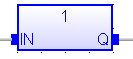
(* The copy is executed only if EN is TRUE *)
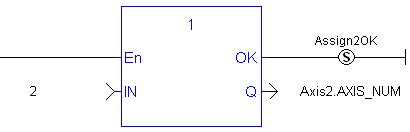
Op1: FFLD IN (* current result is: IN *)
ST Q (* Q is: IN *)
FFLDN IN1 (* current result is: NOT (IN1) *)
ST Q (* Q is: NOT (IN1) *)
FFLD IN2 (* current result is: IN2 *)
STN Q (* Q is: NOT (IN2) *)
See also:
|
Stay Connected with Kollmorgen       
|
Copyright © 2015 Kollmorgen™ |

|