
 Function
 A function calculates a result according to the current value of its inputs. A function has no internal data and is not linked to declared instances. - Limit the ascendance or descendance of a signal.
Inputs
|
Input |
Data Type |
Description |
|---|---|---|
|
IN |
REAL |
Input signal. |
|
ASC |
REAL |
Maximum ascendance during time base. |
|
DSC |
REAL |
Maximum descendance during time base. |
|
TM |
TIME |
Time base. |
|
RST |
BOOL |
Reset. |
Outputs
|
Output |
Data Type |
Description |
|---|---|---|
|
OUT |
REAL |
Ramp signal. |
Time Diagram
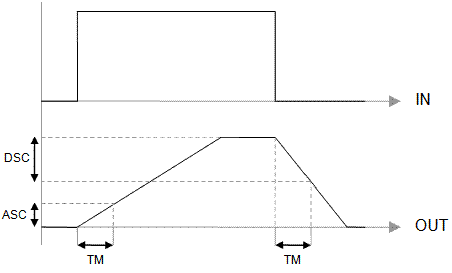
Remarks
- Parameters are not updated constantly.
- They are taken into account only when the:
- first time the block is called.
- reset input (RST) is TRUE.
- In these two situations, the output is set to the value of IN input.
- They are taken into account only when the:
- ASC and DSC give the maximum ascendant and descendant growth during the TB
time base.
- Both must be expressed as positive numbers.
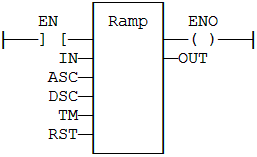
- In the FFLD language, the operation is
executed only if the input rung (EN) is TRUE.
- The output rung (ENO) keeps the same value as the input rung.
ST Language
(* MyRamp is a declared instance of RAMP function block *)
MyRamp (IN, ASC, DSC, TM, RST);
OUT := MyBlinker.OUT;
FBD Language
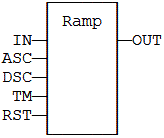
FFLD Language
(* The function is executed only if EN is TRUE *)
(* ENO keeps the same value as EN *)
IL Language
(* MyRamp is a declared instance of RAMP function block *)
Op1: CAL MyRamp (IN, ASC, DSC, TM, RST)
FFLD MyBlinker.OUT
ST


