
 Function
 A function calculates a result according to the current value of its inputs. A function has no internal data and is not linked to declared instances. - Sets the unit for angles in all trigonometric functions.
Inputs
|
Input |
Data Type |
Range |
Unit |
Default |
Description |
|---|---|---|---|---|---|
|
IN |
BOOL |
|
|
|
|
Outputs
|
Output |
Data Type |
Range |
Unit |
Description |
|---|---|---|---|---|
|
Q |
BOOL |
|
|
TRUE if functions use degrees before the call. |
Remarks
This function sets the working unit for these functions:
|
Function |
Description |
|---|---|
|
Arc-cosine |
|
|
Arc-sine |
|
|
Arc-tangent |
|
|
Arc-tangent of Y / X |
|
|
Cosine |
|
|
Sine |
|
|
Tangent |
FBD Language
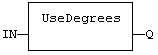
FFLD Language
- The first input is the rung.
- The rung is the output.

IL Language
Op1: LD
UseDegrees
ST Q
ST Language
Q := UseDegrees (IN);


