
 Function
 A function calculates a result according to the current value of its inputs. A function has no internal data and is not linked to declared instances. - Concatenate strings.
Inputs
|
Input |
Data Type |
Range |
Unit |
Default |
Description |
|---|---|---|---|---|---|
|
IN_1 |
STRING |
|
|
|
Any string variable or constant expression. |
|
IN_N |
STRING |
|
|
|
Any string variable or constant expression. |
Outputs
|
Output |
Data Type |
Range |
Unit |
Description |
|---|---|---|---|---|
|
Q |
STRING |
|
|
Concatenation of all inputs. |
Remarks
- In the FBD "Function block diagram"
A function block diagram describes a function between input variables and output variables. A function is described as a set of elementary blocks or FFLD languages, the block can have up to 16 inputs.
- In the IL "Instruction list"
This is a low-level language and resembles assembly or ST "Structured text"
A high-level language that is block structured and syntactically resembles Pascal languages, the function accepts a variable number of inputs (at least 2).
- Use the + operator to concatenate strings.
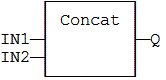
FBD Language
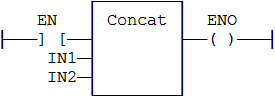
FFLD Language
IL Language
Op1: FFLD     'AB'
     CONCAT 'CD', 'E'
     ST  Q   (* Q is now 'ABCDE' *)
ST Language
Q := CONCAT ('AB', 'CD', 'E');
(* now Q is 'ABCDE' *)


