
 Function
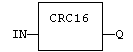
 A function calculates a result according to the current value of its inputs. A function has no internal data and is not linked to declared instances. - calculates a CRC16 on the characters of a string.
Inputs
|
Input |
Data Type |
Range |
Unit |
Default |
Description |
|---|---|---|---|---|---|
|
IN |
STRING |
|
|
|
Character string. |
Outputs
|
Output |
Data Type |
Range |
Unit |
Description |
|---|---|---|---|---|
|
Q |
INT |
|
|
CRC16 calculated on all the characters of the string. |
Remarks
- The function calculates a Modbus ModBus is a serial communications protocol and is now the most commonly available means of connecting industrial electronic devices.
ModBus is often used to connect a supervisory computer with a remote terminal unit in supervisory control and data acquisition (SCADA) systems.
Versions of the ModBus protocol exist for serial port and Ethernet (it is widely used with TCP/IP over Ethernet) CRC16, initialized at 16#FFFF value.
FBD Language
FFLD Language
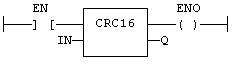
- In the FFLD language, the input rung (EN) enables the operation.
- The output rung (ENO) keeps the same value as the input rung.
- The function is executed only if EN is TRUE.
IL Language
- In the IL "Instruction list"
This is a low-level language and resembles assembly language, the input must be loaded in the current result before calling the function.
Op1: LD
CRC16
ST Q
ST Language
Q := CRC16 (IN);


