
Inputs
|
Input |
Data Type |
Range |
Unit |
Default |
Description |
|---|---|---|---|---|---|
|
IN1 |
ANY |
|
|
|
First input. |
|
IN2 |
ANY |
|
|
|
Second input. |
Outputs
|
Output |
Data Type |
Range |
Unit |
Description |
|---|---|---|---|---|
|
Q |
BOOL |
|
|
TRUE if IN1 = IN2. |
Remarks
- Both inputs must have the same type.
- Comparisons can be used with strings.
- In that case, the lexical order is used for comparing the input strings.
- Example: ABC is less than ZX; ABCD is greater than ABC.
- Equality comparisons cannot be used with TIME variables.
- The reason is that the timer actually has the resolution of the target cycle and test can be unsafe as some values can never be reached.
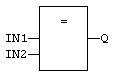
FBD Language
FFLD Language
- In the FFLD language, the input rung (EN) enables the operation.
- The output rung is the result of the comparison.
- The comparison is executed only if EN is TRUE.

IL Language
- In the IL
 "Instruction list"
This is a low-level language and resembles assembly language, the EQ instruction performs the comparison between the current result and the operand.
"Instruction list"
This is a low-level language and resembles assembly language, the EQ instruction performs the comparison between the current result and the operand. - The current result and the operand must have the same type.
Op1: FFLD  IN1
     EQ  IN2
     ST  Q    (* Q is true if IN1 = IN2 *)
ST Language
Q := IN1 = IN2;
See Also


