
 Function Block
 A function block groups an algorithm and a set of private data. It has inputs and outputs. - Pulse When the step gets activated, the action is activated for a single execution, and possibly once again when the step is deactivated timer.
Inputs
|
Input |
Data Type |
Range |
Unit |
Default |
Description |
|---|---|---|---|---|---|
|
IN |
BOOL |
|
|
|
Timer command. |
|
PT |
TIME |
|
|
|
Programmed time. |
|
RST |
BOOL |
|
|
|
Reset (TPR only). |
Outputs
|
Output |
Data Type |
Range |
Unit |
Description |
|---|---|---|---|---|
|
Q |
BOOL |
|
|
Timer elapsed output signal. |
|
ET |
TIME |
|
|
Elapsed time. |
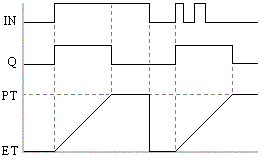
Time Diagram
Remarks
- TPR is same as TP but has an extra input for resetting the timer.
- The timer starts on a rising pulse of IN input.
- It stops when the elapsed time is equal to the programmed time.
- A falling pulse of IN input resets the timer to 0 (zero) but only if the programmed time is elapsed.
- All pulses of IN while the timer is running are ignored.
- The output signal is set to TRUE while the timer is running.
FBD Language

FFLD Language
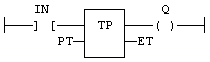
- In the FFLD language, the input rung is the IN command.
- The output rung is Q the output signal.
IL Language
(* MyTimer is a declared instance of TP function block *)
Op1: CAL MyTimer (IN, PT)
     FFLD  MyTimer.Q
     ST  Q
     FFLD  MyTimer.ET
     ST  ET
ST Language
(* MyTimer is a declared instance of TP function block *)
MyTimer (IN, PT);
Q := MyTimer.Q;
ET := MyTimer.ET;
See Also


