MLDerInit

 Function - Initializes an derivator object.
Inputs
|
Input |
Data Type |
Range |
Unit |
Default |
Description |
|---|---|---|---|---|---|
|
BlockID |
DINT |
1 to 1024 |
N/A |
No default |
ID number of a created Pipe Block. |
|
ModuloPosition |
LREAL |
0 to 1.0x10300 |
User units |
No default |
Value of the period of a cyclic system expressed in User units.
Example: If the input value increases each millisecond by one (degree), then the output value is a thousand (degrees per second).
|
Outputs
|
Input |
Data Type |
Range |
Unit |
Description |
|---|---|---|---|---|
|
Default (.Q) |
BOOL |
FALSE, TRUE |
N/A |
|
Remarks
- Function block is automatically called if a Derivator Block is added to the Pipe Network, with user-defined settings entered in the Pipe Blocks Properties screen.
- Input ModuloPosition is defined to manage the periodicity (modulo) of the input values.
-
-
Derivator objects are normally created in the Pipe Network using the graphical engine.
You do not have to add MLDerInit function blocks to their programs.
Parameters are entered directly in pop-up windows and the code is automatically added to the current project.
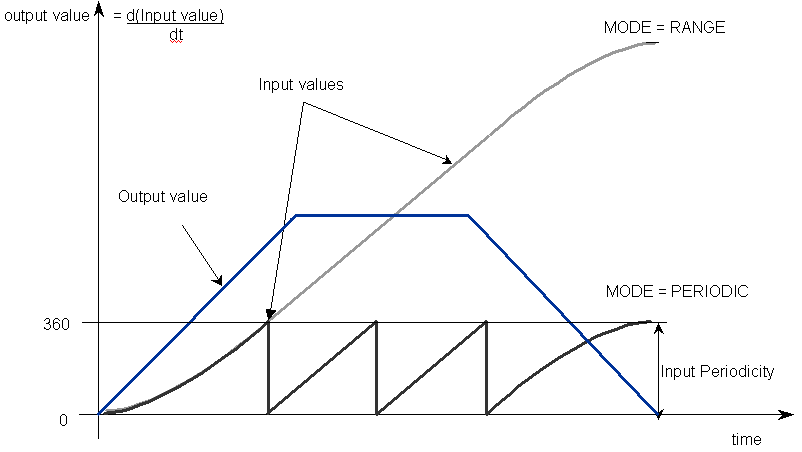
Figure 1: MLDerInit
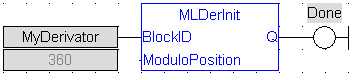
FBD Language Example
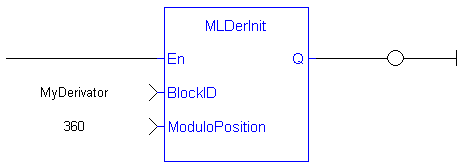
FFLD Language Example
IL Language Example
Not available.
ST Language Example
//Create and Initiate a Derivator object
MyDerivator := MLBlkCreate( 'MyDerivator', 'DERIVATOR' );
MLDerInit( MyDerivator, 360.0 );
See Also


