
 Function Block - Up-counting stop watch (seconds).
Inputs
|
Input |
Data Type |
Range |
Unit |
Default |
Description |
|---|---|---|---|---|---|
|
IN |
BOOL |
FALSE, TRUE |
|
|
The time counts when this input is TRUE. |
|
RST |
BOOL |
FALSE, TRUE |
|
|
Timer is reset to 0 (zero) when this input is TRUE. |
|
PT |
TIME |
|
|
|
Programmed time. (TMU) |
|
PTsec |
UDINT |
|
|
|
Programmed time. (TMUsec - seconds) |
Outputs
|
Input |
Data Type |
Range |
Unit |
Description |
|---|---|---|---|---|
|
Q |
BOOL |
FALSE, TRUE |
|
Timer elapsed output signal. |
|
ET |
TIME |
|
|
Elapsed time. (TMU) |
|
ETsec |
UDINT |
|
|
Elapsed time. (TMU - seconds) |
Remarks
TMUsec is identical to TMU except that the parameter is a number of seconds.
- The timer counts up when the IN input is TRUE.
- It stops when the programmed time is elapsed.
- The timer is reset when the RST input is TRUE.
- It is not reset when IN is false.
Time Diagram
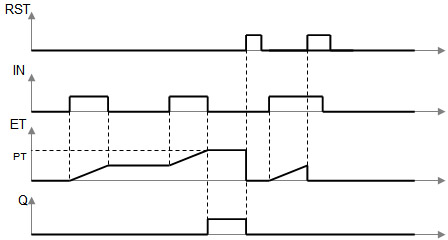
Figure 1: Time Diagram
FBD Language Example
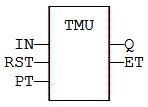
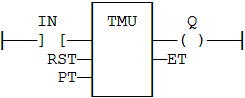
FFLD Language Example
IL Language Example
Not available.
ST Language Example
(* MyTimer is a declared instance of TMU function block *)
MyTimer (IN, RST, PT);
Q := MyTimer.Q;
ET := MyTimer.ET;
See Also


