FileWriteLine

 Function Block - Writes a string value to a text file.
Inputs
|
Input |
Data Type |
Range |
Unit |
Default |
Description |
|---|---|---|---|---|---|
|
Execute |
BOOL |
0 to 1 |
N/A |
No default |
On the rising edge, write a string value to a file. |
|
ID |
UDINT |
N/A |
N/A |
No default |
The ID of the open file. |
|
IN |
STRING |
N/A |
N/A |
No default |
The string value to be written. |
Outputs
|
Output |
Data Type |
Range |
Unit |
Description |
|---|---|---|---|---|
|
Done |
BOOL |
|
|
If TRUE, the command completed successfully. |
|
Error |
BOOL |
|
|
If TRUE, an error has occurred. |
|
ErrorID |
DINT |
|
|
Indicates the error if Error output is TRUE. See the table in File and TCP/IP Function Block ErrorIDs. |
Remarks
An end-of-line character is systematically written after the string value.
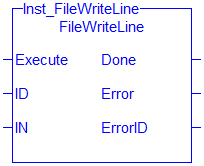
Figure 1: FileWriteLine
String Escape Sequences
For greater formatting control over the STRING output, escape the STRING by pre-pending a $ and use a pre-defined sequence. This is called a string escape sequence.
|
Escape Sequence |
Result |
|---|---|
|
$' |
' |
|
$$ |
$ |
|
$L |
linefeed |
|
$N |
newline |
|
$P |
page (form feed) |
|
$R |
return |
|
$T |
tab |
|
$xx |
hex value |
Example: The is how STRING escape sequences are used.
ID:=FileOpenW('c:\ myfile.txt');
WOK:=FileWriteLine(ID,'123456$N');
//WOK:=FileWriteLine(ID,'$N');
WOK:=FileWriteLine(ID,'abcd$N');
WOK:=FileWriteLine(ID,'the end');
WOK:=FileClose(ID);
The example outputs a file which reads:
123456
abcd
the end
FBD Language Example
Not available.
FFLD Language Example
Not available.
IL Language Example
Not available.
ST Language Example
(* FileWriteLine example *)
CASE StepCounter OF
0:
   Inst_FileWriteLine(TRUE, MyOutputFileID, 'Hello, world.');
   StepCounter := StepCounter + 1;
1:
   Inst_FileWriteLine(TRUE, MyOutputFileID, 'Hello, world.');
   IF Inst_FileWriteLine.Done THEN
      Inst_FileWriteLine(FALSE, 0, '');
      StepCounter := StepCounter + 1;
   END_IF;
END_CASE;
See Also


