DC Bus Link Connector X3
The DC bus link can be connected in parallel so that the power returned from slowing down motors is divided between all the

|
The servo drives can be destroyed if DC bus link voltages are different. Only servo drives with mains supply that share the same AC branch, over current protection devices (identical mains supply voltage) may have the DC bus links interconnected. Interconnection of DC bus links works best in systems powered by 3-phase AC or DC power. Consult Kollmorgen for DC bus linking with single phase AC power input. |
|
|
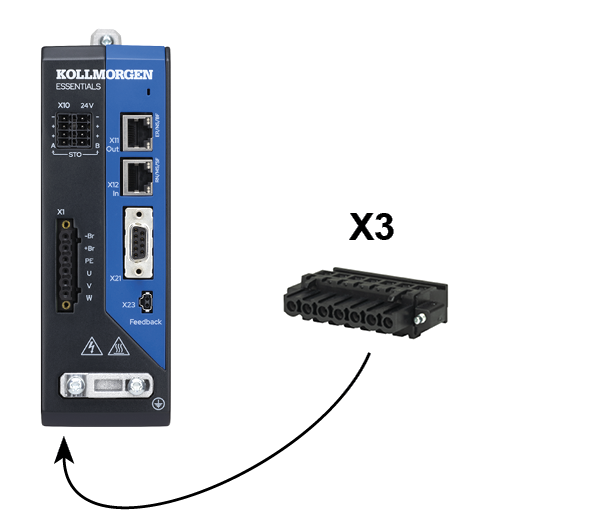
KED-6V03/KED-6V06:
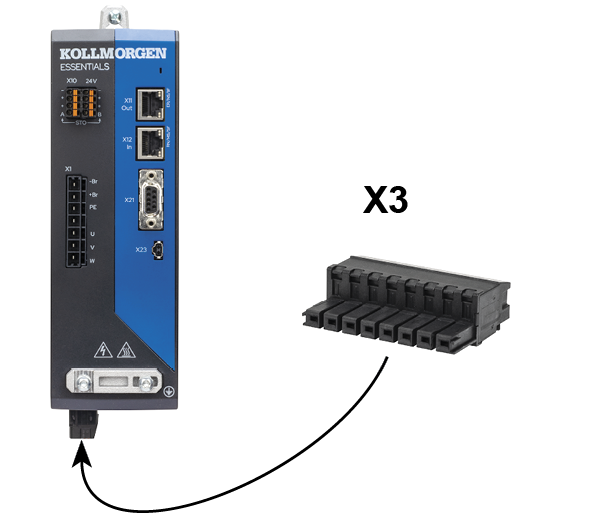
KED-6V12:
Mating connector data (see "Wiring") |
|
Pin |
Label |
Signal |
Description |
|---|---|---|---|
|
7 |
+DC |
+DC |
DC Bus link positive |
|
8 |
-DC |
-DC |
DC Bus link negative |
DC Bus sharing between Kollmorgen Essentials Drives
All servo drives are connected to AC with the same number of phases and the same voltage.
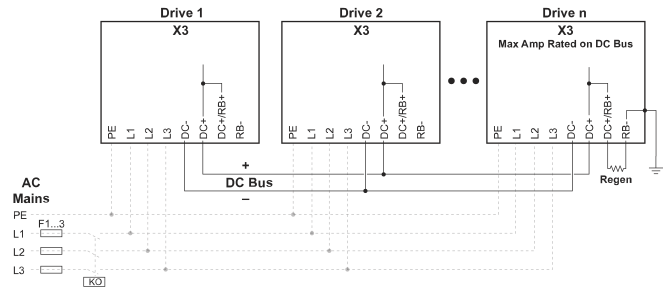
When several units are connected to the same AC mains the units need to be able to share a common DC Bus via the X3 connector, as shown in the following table:
Further explanation:
One DC Bus can be shared by 2 KED-6V03...06 or 3 KED-6V12.
|
|
Connect the regen resistor to the servo drive with the highest current rating. |


