Wiring
General
|
|
There is a danger of serious personal injury or death by electrical shock or electrical arcing.
|


|
Only professional staff who are qualified in electrical engineering are allowed to install the servo drive. Wires with color green with one or more yellow stripes must not be used other than for protective earth (PE) wiring. When installing or replacing cables, use only standardized components, which comply to the cable and wire requirements (see "Wiring"). |

|
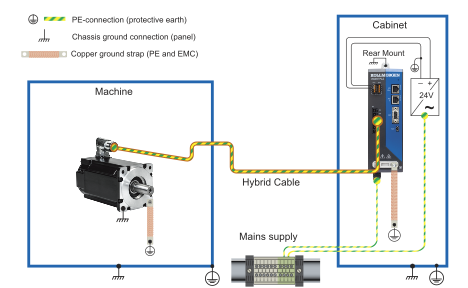
The chassis ground symbol (see (➜ # 1, Symbols Used)) indicates that you must take care to provide an electrically conductive connection with the largest feasible surface area between the unit indicated and the mounting plate in the control cabinet. This connection is for the effective grounding of HF interference, and must not be confused with the PE-symbol (PE = protective earth, safety measure as per IEC 60204). |
Mating connectors
| # |
Description |
Type |
Max. Cross |
|---|---|---|---|
|
X1 |
Motor, holding brake |
Connector, 4 pol. power |
10 mm², 8 awg |
|
X3 |
Mains power, regen resistor, DC-Bus |
Connector or T-type, 8 pol. |
6 mm², 10 awg |
|
X10 |
24V power supply, STO input |
Connector, 8 pol. |
1.5 mm², 14 awg |
|
X21 |
I/O control signals |
Connector, DB9 (9-pin D-sub) |
1.5 mm², 16 awg |
|
X23 |
Motor feedback |
2-pin connector |
|
Cable and Wire Requirements
The Kollmorgen Essentials Drive has one motor cable (X1) which you can use for all motors.
For information on the chemical, mechanical, and electrical characteristics of the cable please refer to the Essentials Cables section or contact our customer support.
Motor cable (X1):
- Max. cable length: 25m / 50m with choke
Notice: Cables should not exceed the maximum lengths. The recommended maximum cable length of motor cables depends on the used cable material and the feedback type. Cable functionality is only guaranteed up to the maximum length when using unmodified Kollmorgen engineered cables. - Supports SFD-M and SFD3
I/O cable (X21):
- Maximum distance for unshielded I/O lines is 3m inside the cabinet.
- If the I/O cable leaves the cabinet, ensure EMC shielding.
Cable cross sections and requirements
The tables below describe the recommended interface cross sections and cable requirements related to Kollmorgen Essentials Drive in accordance with IEC 60204.
|
Power Cables |
Cross Section |
Remarks | ||
|---|---|---|---|---|
|
EU |
US |
|||
|
Mains supply |
3 A: |
1.5 mm² |
14 awg |
600 V rated, minimum 75°C |
|
24 V supply |
max. |
1.5 mm² |
14 awg |
Single core Flexible Class 5 |
|
DC bus link, |
3/6 A: |
1.5 mm² |
14 awg |
1000 V rated, min. 75°C, shielded for lengths >0.20 m |
|
I/O cables |
||||
|
Digital I/Os |
|
0.5 mm² |
20 awg |
single core |
Kollmorgen Essentials Hybrid Cable Wiring Specifications
|
Cable |
Type |
Cross Section [mm2] |
Current Carrying |
Remarks |
|---|---|---|---|---|
|
H2-51-015-A5-xxxx00 |
Power + Brake + SFD-M/ SFD3
|
(4x1.5+(2x0.34)+(2x0.75)) |
10.1A < I0rms ≤ 13.1A |
1000 V rated, 80°C Current carrying capacity acc. to IEC 60204-1:2006 Table 6, Column B2 4 power lines & |
|
H2-51-025-A5-xxxx00 |
(4x2.5+(2x0.34)+(2x1.0)) |
13.1A < I0rms ≤ 17.4A |
Protective Earth Connection
Protective Earth connection of the system components is a safety measure per IEC 60204. Ensure the proper grounding of all components with the PE rail in the control cabinet as reference potential. Connect each ground individually with the intended grounding cable (neutral point connection).
The leakage current from Kollmorgen Essentials Drive against PE is more than 3.5 mA. In accordance with EN 61800-5-1, the PE connection must therefore either be double implemented or a connection cable with >10 mm² cross-section used.
In order to keep the impedance as low as possible, we recommend a copper earthing strap for the PE connection on the PE block.
|
|
Wire the PE connections immediately after installing the devices as the first electrical connection. Now you insert all the other lines and connectors. For disassembly, release the PE connections as the last connection. |
|
|
For the use of residual current protective devices (RCD), refer to (➜ # 1). |


