You are here: Advanced Topics > Coordinated Motion > How-To: Coordinated Motion > Line-to-Arc and Arc-to-Line Transitions

Line-to-Arc and Arc-to-Line Transitions

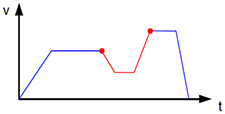
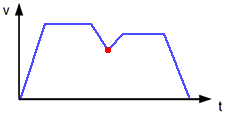
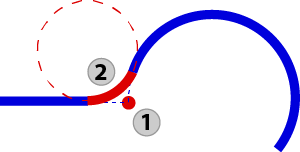
With this transition mode, the linear move is shortened when one move is linear and the other is circular. The amount is specified by the corner distance. A circular arc connects the two moves (except as noted below), allowing for a smooth transition (see n-Degree Transition below). The circular arc that connects the two moves derives its velocity from the transition parameter and the acceleration and deceleration values are derived from the next move.

Motion Path - Line-to-Arc / Arc-to-Line Key Motion Velocity Profile

Blue: Incoming, outgoing linear and circular motion

Red: Transition arc

  1. Original start/endpoint of linear move
  2. Corner distance

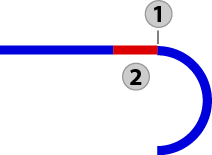
Figure 11-6: n-Degree Transition

Blue: Incoming, outgoing linear and circular motion

Red: Transition line segment

  1. Original start/endpoint of linear move
  2. Corner distance

Figure 11-7: Tangent Transition: Line is tangent to the arc

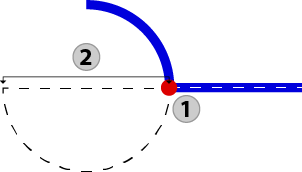
Dashed: Original shape

Blue: Incoming, outgoing linear and circular motion

Red: Zero distance transition

  1. Original endpoint of 1st move
  2. Corner distance

Figure 11-8: Intersection Transition: The line intersects the arc a "corner distance" away from the beginning of the new move.
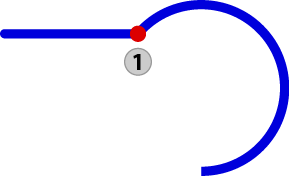
Blue: Incoming, outgoing linear and circular motion

Red: Zero distance transition

  1. Original endpoint of 1st move

Figure 11-9: 0-Distance Transition: Special behavior for 0-distance transitions.


Stay Connected with Kollmorgen

Copyright © 2015 Kollmorgen™