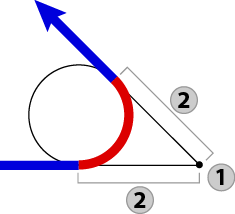
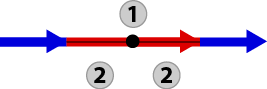
Blue: Incoming, outgoing linear motion
Red: Transition arc
- Original endpoint of 1st move
- Corner distance
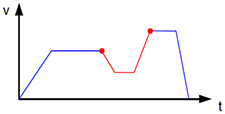
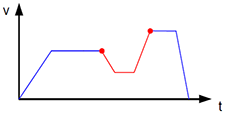
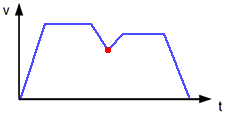
When both moves are linear the current and next moves are shortened using this transition mode. The amount is specified by the corner distance. A circular arc connects the two moves (except as noted below), allowing for a smooth transition (see n-Degree Transition below). The circular arc that connects the two moves derives its velocity from the transition parameter and the acceleration and deceleration values are derived from the next move.
There are three special cases for line to line transitions:
| Motion Path - Line to Line | Key | Motion Velocity Profile |
|---|---|---|
|
|
Blue: Incoming, outgoing linear motion Red: Transition arc
|
|
|
Stay Connected with Kollmorgen       
|
Copyright © 2015 Kollmorgen™ |

|
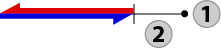
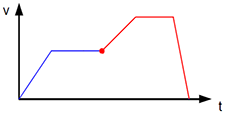
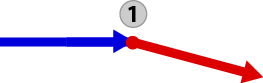
 . There is no transition arc. A sudden change in the direction of motion may result in large jerks to the axes.