
 Function
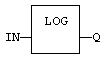
 A function calculates a result according to the current value of its inputs. A function has no internal data and is not linked to declared instances. - Calculates the logarithm (base 10) of the input.
Inputs
|
Input |
Data Type |
Range |
Unit |
Default |
Description |
|---|---|---|---|---|---|
|
IN |
REAL / LREAL |
|
|
|
Real value. |
Outputs
|
Output |
Data Type |
Range |
Unit |
Description |
|---|---|---|---|---|
|
Q |
REAL / LREAL |
|
|
Result: Logarithm (base 10) of IN. |
Remarks
None
FBD Language Example
FFLD Language Example
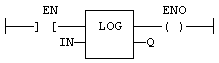
- In the FFLD "Free Form Ladder Diagram" Language, the operation is executed only if the input rung (EN) is TRUE.
- The output rung (ENO) keeps the same value as the input rung.
- The function is executed only if EN is TRUE.
- ENO has the same value as EN.
IL Language Example
- In the IL "Instruction List"
This is a low-level language and resembles assembly Language, the first input must be loaded before the function call.
Op1: LD
LOG
ST Q (* Q is: LOG (IN) *)
ST Language Example
Q := LOG (IN);
See Also


