
Inputs
|
Input |
Data Type |
Range |
Unit |
Default |
Description |
|---|---|---|---|---|---|
|
IN1 |
BOOL |
|
|
|
First Boolean input. |
|
IN2 |
BOOL |
|
|
|
Second Boolean input. |
Outputs
|
Output |
Data Type |
Range |
Unit |
Description |
|---|---|---|---|---|
|
Q |
BOOL |
|
|
Boolean OR of all inputs. |
Remarks
None
Truth Table
|
IN1 |
IN2 |
Q |
|---|---|---|
|
0 |
0 |
0 |
|
0 |
1 |
1 |
|
1 |
0 |
1 |
|
1 |
1 |
1 |
FBD Language Example
- The block is called >=1.
- The block can have a maximum of 32 inputs.
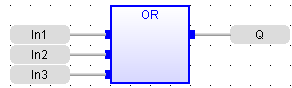
FFLD Language Example
- In the FFLD Language, an OR operation is represented by contacts in parallel.
Example: Parallel contacts:
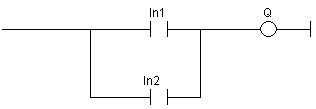
IL Language Example
- The OR instruction performs a logical OR between the current result and the operand.
- The current result must be Boolean.
- The ORN instruction performs an OR between the current result and the Boolean negation of the operand.
Op1: FFLD  IN1
     OR  IN2
     ST  Q   (* Q is equal to: IN1 OR IN2 *)
Op2: FFLD  IN1
     ORN IN2
     ST Q    (* Q is equal to: IN1 OR (NOT IN2) *)
ST Language Example
Q := IN1 OR IN2;
Q := IN1 OR IN2 OR IN3;
See Also


