
 Function - Select one of the two integer inputs.
Inputs
|
Input |
Data Type |
Range |
Unit |
Default |
Description |
|---|---|---|---|---|---|
|
G |
BOOL |
FALSE, TRUE |
|
|
Selection command. |
|
IN0 |
ANY |
|
|
|
First input. |
|
IN1 |
ANY |
|
|
|
Second input. |
Outputs
|
Output |
Data Type |
Range |
Unit |
Description |
|---|---|---|---|---|
|
Q |
ANY |
|
|
|
Remarks
None
Truth Table
|
G |
Q |
|---|---|
|
0 |
IN0 |
|
1 |
IN1 |
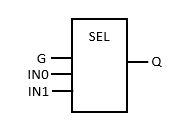
FBD Language Example
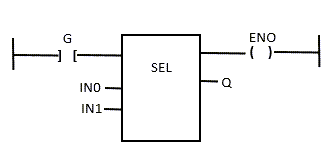
FFLD Language Example
- In the FFLD Language, the selector command is the input rung.
- The output rung keeps the state of the input rung.
- ENO has the same value as SELECT.
IL Language Example
- In the IL Language, the first parameter (selector) must be loaded in the current result before calling the function.
- Other inputs are operands of the function, separated by comas.
Op1: LD  SELECT
     SEL IN1, IN2
     ST  Q
ST Language Example
Q := SEL (G, IN0, IN1);
See Also


