
 Function Block - Manages a last in / first out list.
Inputs
|
Inputs |
Data Type |
Range |
Unit |
Default |
Description |
|---|---|---|---|---|---|
|
BUFFER |
ANY |
|
|
|
Array for storing values. |
|
NEXTOUT |
ANY |
|
|
|
|
|
NEXTIN |
ANY |
|
|
|
Value to be pushed. |
|
POP |
BOOL |
|
|
|
Pop a new value on the rising edge. |
|
PUSH |
BOOL |
|
|
|
Push a new value on the rising edge. |
|
RST |
BOOL |
|
|
|
Reset the list. |
Outputs
|
Outputs |
Data Type |
Range |
Unit |
Description |
|---|---|---|---|---|
|
EMPTY |
BOOL |
|
|
TRUE if the list is empty. |
|
OFLO |
BOOL |
|
|
TRUE if the overflow is on a PUSH command. |
|
Count |
DINT |
|
|
Number of values in the list. |
|
pRead |
DINT |
|
|
Index in the buffer of the top of the stack. |
|
pWrite |
DINT |
|
|
Index in the buffer of the next push position. |
Remarks
- NEXTIN, NEXTOUT, and BUFFER must have the same data type.
- It cannot be a STRING.
- The NEXTOUT argument specifies a variable filled with the value at the top of the stack after the block is called.
- Values are stored in the BUFFER array.
- Data is never shifted or reset.
- Only read and write pointers and pushed values are updated.
- The maximum size of the stack is the dimension of the array.
- The first time an instance of the LIFO function block is called, that instance stores which array is passed to BUFFER.
- If a later call to the same instance passes a different array for the BUFFER argument, the call is considered invalid and no action is performed.
- The EMPTY output returns TRUE in this case.
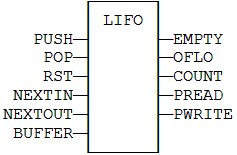
FBD Language Example
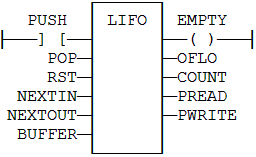
FFLD Language Example
- In the FFLD Language, the input rung is the PUSH input.
- The output rung is the EMPTY output.
IL Language Example
Not available.
ST Language Example
(* MyLIFO is a declared instance of LIFO function block. *)
MyLIFO (PUSH, POP, RST, NEXTIN, NEXTOUT, BUFFER);
EMPTY := MyLIFO.EMPTY;
OFLO := MyLIFO.OFLO;
COUNT := MyLIFO.COUNT;
PREAD := MyLIFO.PREAD;
PWRITE := MyLIFO.PWRITE;
See Also


