You are here: Technical References > Application Modules > Unwind-Rewind > Project Overview

Project Overview

Project Picture

Below is the KAS IDE"Integrated development environment" An integrated development environment is a type of computer software that assists computer programmers in developing software. IDEs normally consist of a source code editor, a compiler and/or interpreter, build-automation tools, and a debugger Project Explorer view of the application:
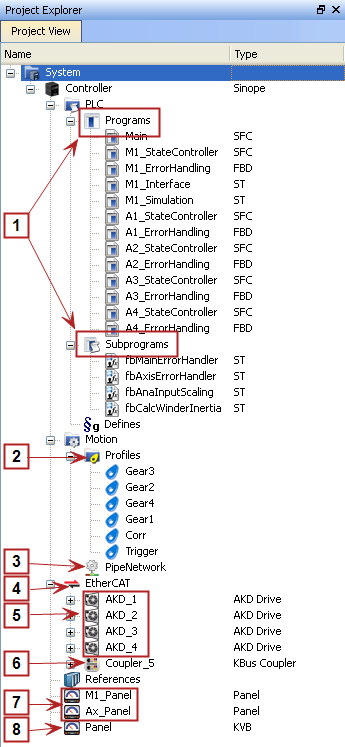
  1. PLC"Programmable Logic Controller" A Programmable Logic Controller, PLC, or Programmable Controller is a digital computer used for automation of industrial processes, such as control of machinery on factory assembly lines. Used to synchronize the flow of inputs from (physical) sensors and events with the flow of outputs to actuators and events Programs and Subroutines
  2. CAMs
  3. PipeNetwork (PN) editor
  4. EtherCATEtherCAT is an open, high-performance Ethernet-based fieldbus system. The development goal of EtherCAT was to apply Ethernet to automation applications which require short data update times (also called cycle times) with low communication jitter (for synchronization purposes) and low hardware costs network
  5. DriveControl device for regulating the speed, torque and position of a motor configuring and commissioning
  6. Remote I/O commissioning
  7. Internal Control Panel used during start-up and for troubleshooting
  8. HMI"Human-machine interfaces " Also known as computer-human interfaces (CHI), and formerly known as man-machine interfaces, they are usually employed to communicate with PLCs and other computers, such as entering and monitoring temperatures or pressures for further automated control or emergency response

PLC Program Overview

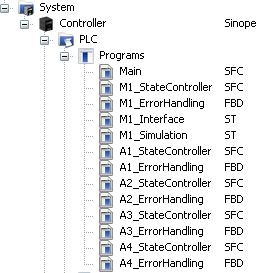
This project makes use of a template that contains separate programs for individual axis level motion, multi-axis level motions and error handling both at the axis and main (or machine) levels:
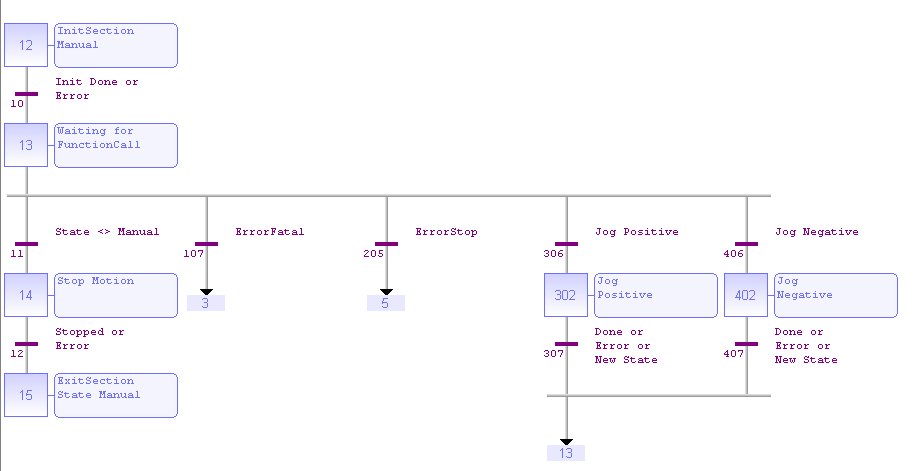
The State Controller programs contain SFC"Sequential function chart" It can be used to program processes that can be split into steps. The main components of SFC are: - Steps with associated actions - Transitions with associated logic conditions - Directed links between steps and transitions code that incorporates sections (of steps and transitions) for each machine state: Standby, Manual, Automatic, Error Stop, and Error Fatal. Particular sections will only contain code when it is necessary. Example 1: for making manual motion at the axis level the A1_StateController program contains code in the following Manual state section of the SFC program:
Example 2: In the A1_StateController Automatic section there is no code to make motion since this is handled by the Automatic Mode operation in the M1_StateController program.

The programming language in each step is typically ST"Structured text" A high-level language that is block structured and syntactically resembles Pascal.


Stay Connected with Kollmorgen

Copyright © 2015 Kollmorgen™