MLPipeDeact

 Function - Deactivates a pipe.
A Pipe contains an Input Pipe Block (Master, PMP, or Sampler), a Converter Output Pipe Block, and any Transformation Pipe Block that can be in between.
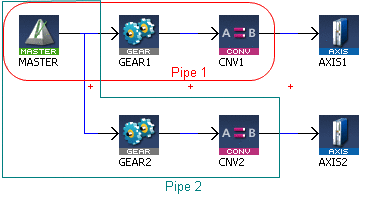
- The MLPipeDeact image shows two Pipes, both with the same Master Input Pipe Block.
- The first ends with the first converter and has a Gear Pipe Block to transform the input values from the Master.
- The second ends with the second converter and has a CAM Pipe Block to modify the input values from the Master.
- Once a Pipe is activated, history on the values in the Pipe's Blocks are lost and no longer updated.
- A Converter object connected to a destination Axis object cannot send updated position values once its Pipe is deactivated.
-
-
- All Pipes in the Pipe Network can be deactivated at once with the command PipeNetwork(MLPN_DEACTIVATE).
- This calls automatically generated code with MLPipeDeact commands for each Pipe object.
- In a multi-pipe program, only one command can be used to deactivate Pipes instead of writing code for each Pipe separately.
Inputs
|
Input |
Data Type See Data Types. |
Range |
Unit |
Default |
Description |
|---|---|---|---|---|---|
|
PipeID |
DINT |
1 to 1024 |
N/A |
No default |
ID number of a created Pipe object. |
Outputs
|
Output |
Data Type See Data Types. |
Range |
Unit |
Description |
|---|---|---|---|---|
|
Default (.Q) |
BOOL |
FALSE, TRUE |
N/A |
|
FBD Language Example

FFLD Language Example
IL Language Example
Not available.
ST Language Example
//Deactivate a Pipe
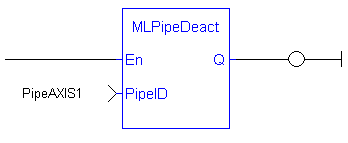
MLPipeDeact( PipeAXIS1 );
See Also
- MLCNVDisconnect
- MLPipeAct
- MLPipeAddBlock
- MLPipeCreate
- Pipe Network Functions for the PLC - MLPN_DEACTIVATE


